

How It All Started
A note of gratitude to 1,000 readers

Over 1,000 people now read What Schools Forget.

I didn’t see that coming.
Here’s how it started.
Several years ago, the faculty at my school were reading and discussing Plato’s Republic. In Book VII, Socrates gives the famous “Allegory of the Cave”, but what was more striking was what Socrates discusses afterwards.
Socrates argues that mathematics is the study that most compels the soul toward true philosophy.
Then it would be fitting, Glaucon, to set this study [mathematics] down in law and to persuade those who are going to participate in the greatest things in the city to go to calculation and to take it up, not after the fashion of private men, but to stay with it until they come to the contemplation of the nature of numbers with intellection itself, not practicing it for the sake of buying and selling like merchants or tradesmen, but for war and for ease of turning the soul itself around from becoming to truth and being.
…Do you see, then, my friend," I said, "that it's likely that this study is really compulsory for us, since it evidently compels the soul to use the intellect itself on the truth itself?
This also caught the attention of the administration at my school.
Since then, I started meeting weekly with the headmaster and the heads of lower and middle school to discuss math. Every week, for an entire hour, we sought to get to the bottom of what math really is and how to teach it well.
While it is impossible to answer either of those questions completely and with certainty, we started to make sense of them. One thing we realized is that we were not teaching what the ancients considered to be true mathematics.
This drove me to start exploring the history of math curricula. I wanted to know where our curriculum came from, who created it, and why.
The answers to these questions led me deeper and deeper into a rabbit hole of the history of education in general. I realized that I could not merely focus on mathematics, but I had to look into history of our educational system as a whole.
The Rabbit Hole
As I began exploring the history of education in the United States, I realized that the historical narrative was still very much up for debate.
The more I read, the more confused I became. Conflicting histories, competing narratives, unreliable secondary sources. So I went to the primary sources. I started taking copious notes on the writings of what seemed like the 10 most important historical figures. Quickly the list of important people grew to 20, then 50…
Eventually, I decided to write something. People needed to hear about what I was learning.
I hadn’t written an essay since college, over 15 years prior. The last long-form article I wrote was a paper in graduate school on a tool for studying the brain. That was ten years ago.
What if nobody cared?
I tried submitting articles to various online journals and finally one was published in Public Discourse.
I am forever grateful to Public Discourse for giving me the momentum and confidence to continue writing. Since then I have published in the CiRCE Institute, the Washington Examiner, The Imaginative Conservative, The Liberty Sentinel, The Civitas Institute at UT Austin, and the Australian Classical Education Society
But I had a lot to say, and not enough time to get those ideas published in media outlets. That’s why I started What Schools Forget.
Publishing What Schools Forget
A friend who writes for the Washington Examiner recommended that I start a Substack to gain notoriety and readership.
When I started writing What Schools Forget a little over a year ago, I had no idea what Substack was and how to use it. Nervous? Yes. Excited? Yes. Confident? No.
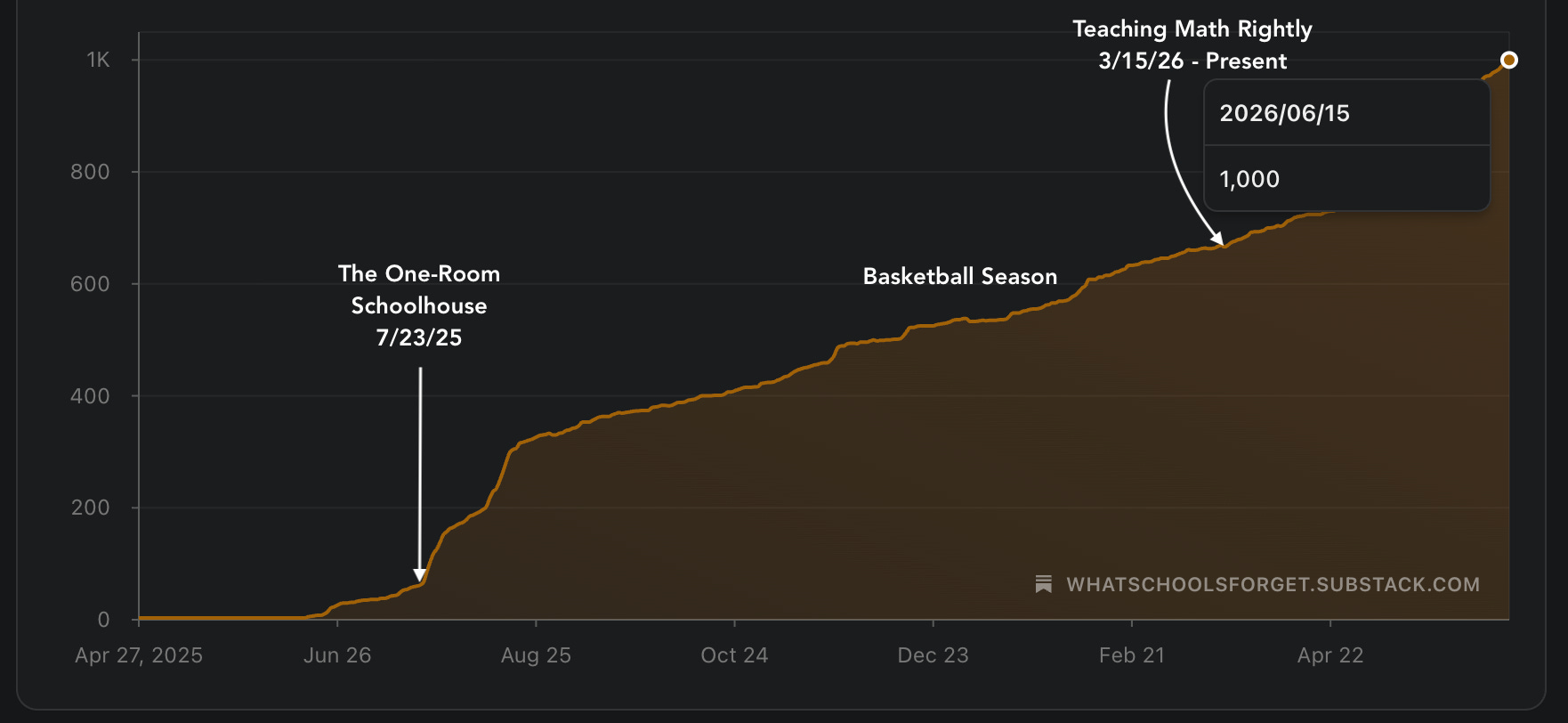
In April of 2025, I started building up my Substack profile and making the website look halfway decent. For two months, I had three subscribers: myself, my work email, and my friend from the Washington Examiner.
Getting an article published in Public Discourse gave the confidence I needed to really commit to Substack. In June, I “officially published” my Substack by sending out an announcement on LinkedIn and emailing friends and family to ask for their support.
Within a few weeks, I had over 30 subscribers, with more trickling in each day.
Then in July I started writing a series called “Schools and Schooling.” Initially, there was not a whole lot of traction, but then on July 23 I struck some sort of chord with an article on the one-room schoolhouse.
The One-Room Schoolhouse: how bad was it?

In 1924, Texas education reformers thought they had an easy task: prove that one-room schoolhouses were educational failures. They brought in nationally prominent experts and conducted an in-depth comparative study, fully expecting to find that modern consolidated schools dramatically outperformed these rural relics. Instead, they discovered the opposite.
One hundred of you joined me in a single week. I still don’t fully understand why that article struck such a chord, but your response told me I was onto something real.
In early August, I started to intersperse my writing on history of education with articles on math. Many people really enjoy thinking about mathematics, almost as much as I do. These articles sparked a lot of interest, and people kept on subscribing and giving (mostly) positive feedback on my work.
Teaching and [Re]Learning Mathematics
![Teaching and [Re]Learning Mathematics](https://substackcdn.com/image/fetch/$s_!E8zZ!,w_280,h_280,c_fill,f_webp,q_auto:good,fl_progressive:steep,g_auto/https%3A%2F%2Fsubstack-post-media.s3.amazonaws.com%2Fpublic%2Fimages%2Ff04a9f52-d044-4a15-aebb-a47d22ff1222_2048x2048.png)
This is going to be a “live” post, that I will try to update regularly with new discoveries and rediscoveries. I may at some point refine and re-organize it better, too. If you think I have missed anything or should take something away, please send me a message or drop a comment on this post.
As the school year began, I had to dedicate more time to teaching and less to writing.
I published a couple of articles in media outlets, but did less writing on Substack.
In early 2026, my commitments at school increased. I began coaching basketball, which was an incredible experience, but that meant I had far less time to write.
In March, when the basketball season ended, several hundred of you had subscribed. I started writing a series of weekly articles on mathematics, announcing the series with a passionate post.

This series arose from years of experience and several conversations with parents and teachers about how to teach math better. It crystallized when my brother asked me for advice because his daughter, my goddaughter, was struggling with algebra.
One article on the number line was particularly popular.
The Number Line Is A Tricky Beast, Part I

This is the second installment of my “Teaching Math Rightly” series.My goal is to explore some of the challenges teachers and parents encounter when guiding children through the mysterious and wonderful world of mathematics. See the previous article
My readership was growing. My growth rate increased to around 5-10 new subscribers per day.
That brings us to today. One thousand of you reading about what schools forget. I still find that remarkable.
Coming Next
The word “classical” gets thrown around a lot. But classical education as most schools practice it today is not actually ancient, or medieval, or even early modern. It's a 20th century movement and it largely traces back to a single 1947 essay by Dorothy Sayers.
Many classical schools say they are committed to reading the “Great Books.” I do not doubt that they are. The “Great Books” movement, however, also has an interesting history, arising from a group of professors at University of Chicago in the early 20th century.
The liberal arts: that’s where the treasure lies. With roots in ancient Greece, the liberal arts were not fully systematized as such until Late Antiquity and the early Middle Ages by people like Martianus Capellus and Boethius. Modern education, if it truly seeks to be classical and to teach the liberal arts, must return to these great writers.
That's what I want to explore next.
Invite your friends to read What Schools Forget
If What Schools Forget has been worth reading, the best thing you can do is share it with one person who would appreciate it. A teacher, a parent, a homeschooler, someone who cares about education.
Substack has a built-in referral program that rewards you for sharing. Details below.
But honestly, just forwarding an article to one person matters more than any program.
How to participate
1. Share What Schools Forget. When you use the referral link below, or the “Share” button on any post, you’ll get credit for any new subscribers. Simply send the link in a text, email, or share it on social media with friends.
2. Earn benefits. When more friends use your referral link to subscribe (free or paid), you’ll receive special benefits.
Get a 1 month comp for 3 referrals
Get a 3 month comp for 5 referrals
Get a 6 month comp for 25 referrals
Thank you for helping get the word out about What Schools Forget!