

Numbers on a line…what could be wrong with that? A lot. But before we can understand what’s wrong with it, we need to understand where it came from and that history is more surprising than you might expect.
Discrete vs. Continuous
Depending on the school, a child is introduced to the number line as early as 1st or 2nd grade. But this represents an incredible shift in mindset. The transition from counting things, discrete and distinguishable, to counting on a continuous number line is an enormous shift. For centuries, math was taught without the number line. Then, in the 1950’s, it was introduced by advocates of “New Math”, which on the whole was a failure. The number line tool in the mathematics classroom is a vestige from the “New Math” era, and if it is not used properly it can cause serious harm to a child’s understanding of what numbers are.
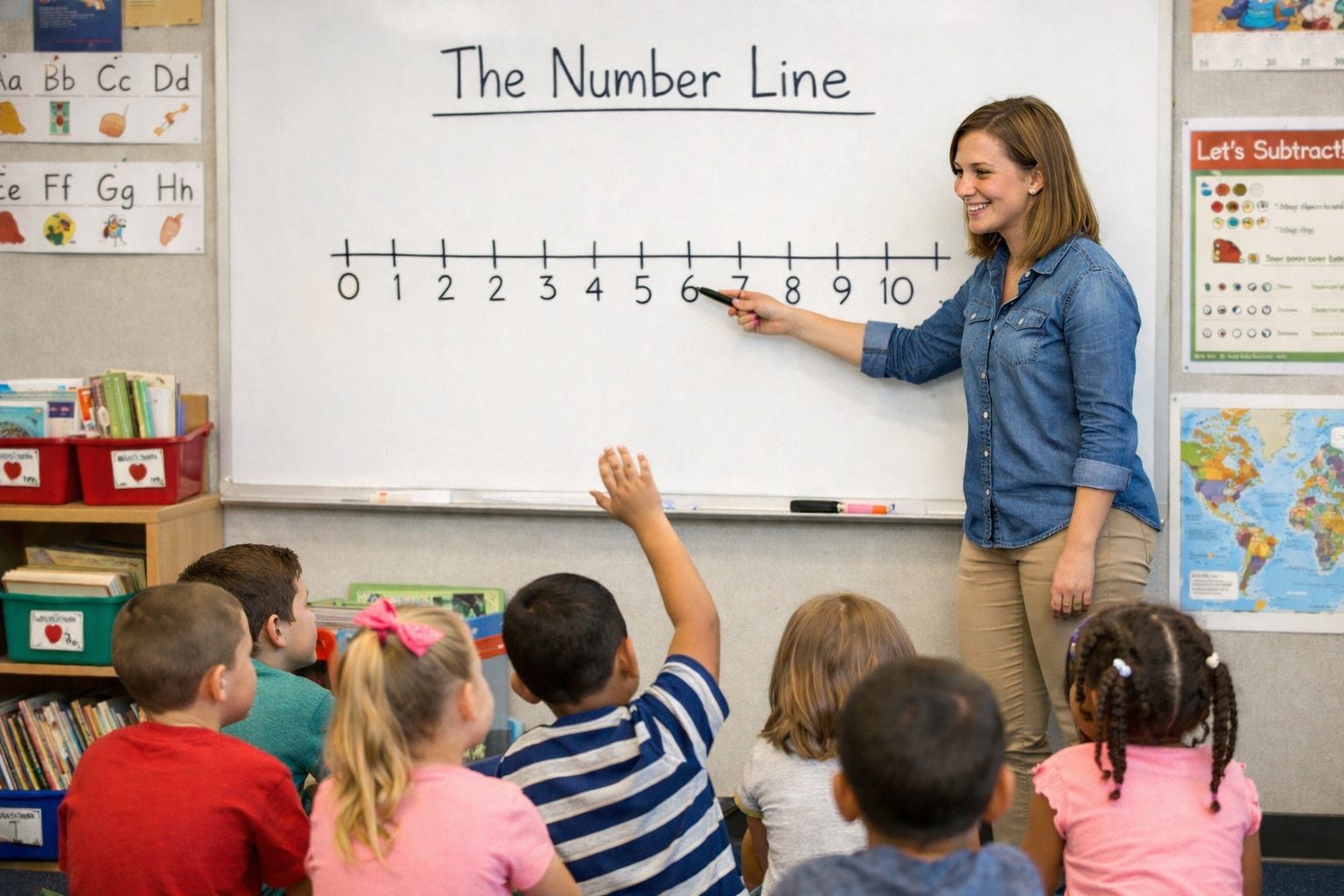
The understanding of number as discrete never quite goes away. Ask almost anyone “What number comes after 7?” They will confidently answer, “8.” Children learn eventually, and with a great sense of accomplishment, that the number after “ninety-nine” is “one hundred.” Ask a mathematician, and, if he’s got his wits about him, he’ll respond to your question with a question, “What kind of number are you referring to?”
For those of us who are very familiar with number lines and Cartesian coordinate planes, the assignment of numbers to points on a line can appear too obvious to require explanation. But the introduction of the number line not only took centuries as a development in mathematics, it is only in the past century that it was introduced to primary and secondary math classrooms.
The History of the Number Line
The Ancient Distinction Between Number and Magnitude
Aristotle identifies “quantity” as a characteristic of all material things. By quantity, Aristotle means number and magnitude (shape, size, extension). He distinguishes between number and magnitude by the fact that magnitudes are continuous, whereas numbers are discrete.
The parts of a number have no common boundary, whereas the parts of magnitude do. Three and seven are parts of ten, but there is no common boundary of three and seven where three joins to seven to compose ten. Now consider a line segment AB with a point C on the segment. The parts of segment AB are AC and CB. They do have a common boundary, namely the point C, where the conjoined parts, AC and CB, make up the whole segment, AB.
This distinction between number and magnitude is not purely abstract. It is a distinction in the material world. We never sense numbered magnitude or continuous number in daily life.
A ruler comes to mind as the exception to this distinction. This appears to be a “numbered magnitude”. A ruler, most simply considered, is a line with numbers labelled corresponding to the distinct units of measure. Each subsequent unit, however, is only countable insofar as it is labelled. There is no separation between the units, and so it is continuous quantity, not discrete quantity. The three-inch mark, for example, does not perfectly measure three inches. At best, a close approximation can be made. If you look at three apples, on the other hand, you can count the three apples with trivially perfect accuracy.
In the Elements, Euclid makes a clear distinction between discrete quantity (number) and continuous quantity (magnitude). Discrete quantity answers the question, “how many?” Continuous quantity (magnitude) answers the question, “how much?” I will be exploring this distinction more in a later article.
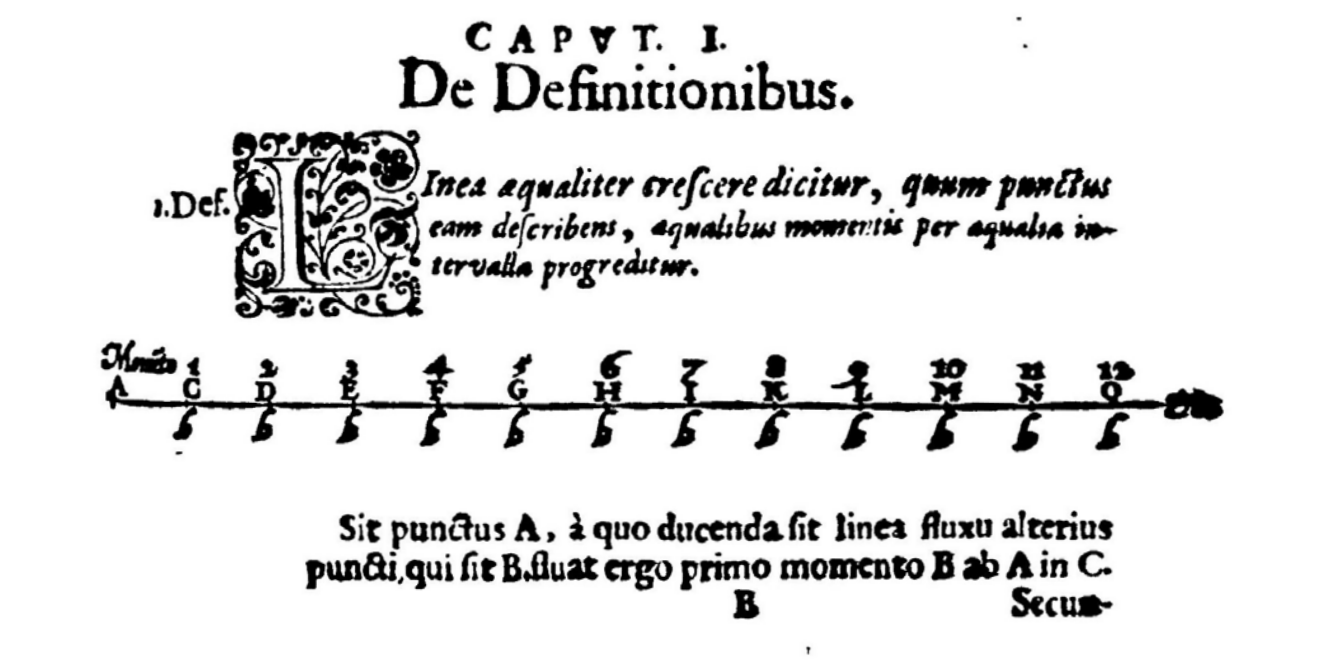
Descartes “La Geometrie”
This discussion would be incomplete without making mention of René Descartes’ La Géométrie. In this landmark work, Descartes redefined the multiplication of line segments so that the product of two segments is always another segment. This was a seemingly small shift, but one with profound consequences.
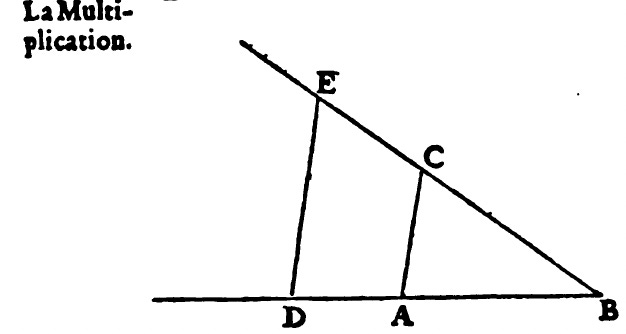
In traditional geometry, multiplying two line segments produced an area, and multiplying three produced a volume. Beyond that, the system broke down: there was no intuitive way to represent four-, five-, or higher-dimensional products geometrically. Since geometry remained the primary tool for solving algebraic problems even in Descartes’ time, a method that simplified geometric multiplication was enormously powerful. Using it, Descartes solved the five-line locus problem, a challenge that had gone unsolved since Pappus posed it in the 4th century AD.
Under this new definition, multiplying four line segments of lengths w, x, y, and z no longer implied a four-dimensional volume. It simply produced a line of length wxyz. With this, Descartes unified arithmetic and geometry into what we now call analytic geometry. Using analytic geometry, Descartes was able to describe geometrical curves and figures using algebra. This facilitated solutions to problems which up until that point were only solved geometrically.
The elegance of this unification is easy to take for granted today. When we do algebra, we never think that x² might represent an area or x³ a volume. We take for granted that these variable expressions are simply numbers, even in the context of geometry. In a sense, we all think like Cartesians now. In short, Descartes made it possible to treat geometry and arithmetic as the same thing, which is why your child’s math textbook moves freely between the two.
But this conflation of numbers and magnitudes, of discrete quantity and continuous quantity was not without problems. Under a veil of simplicity were hidden issues that have plagued mathematicians since Euclid’s time.
John Wallis
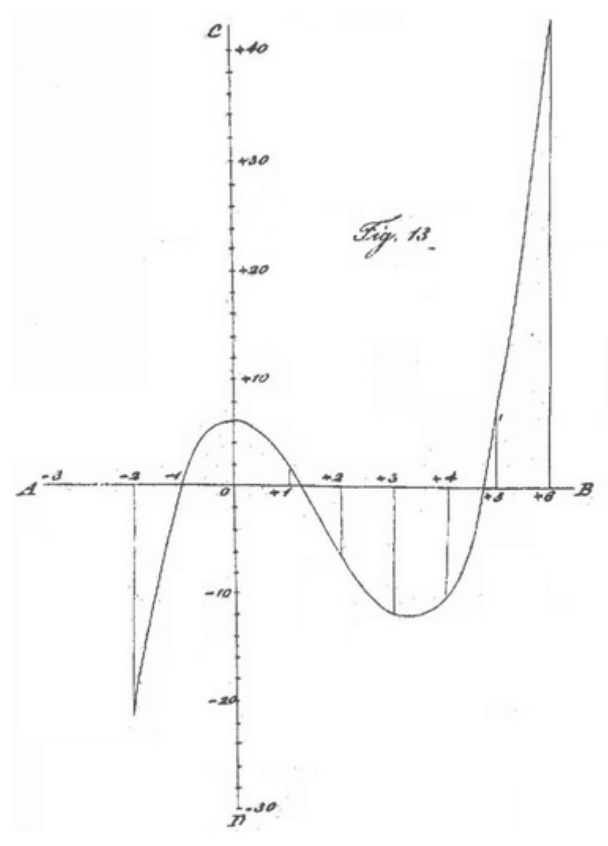
John Wallis is credited as having first introduced the number line to arithmetical operations of addition and subtraction with negative numbers in his 1685 Treatise on Algebra
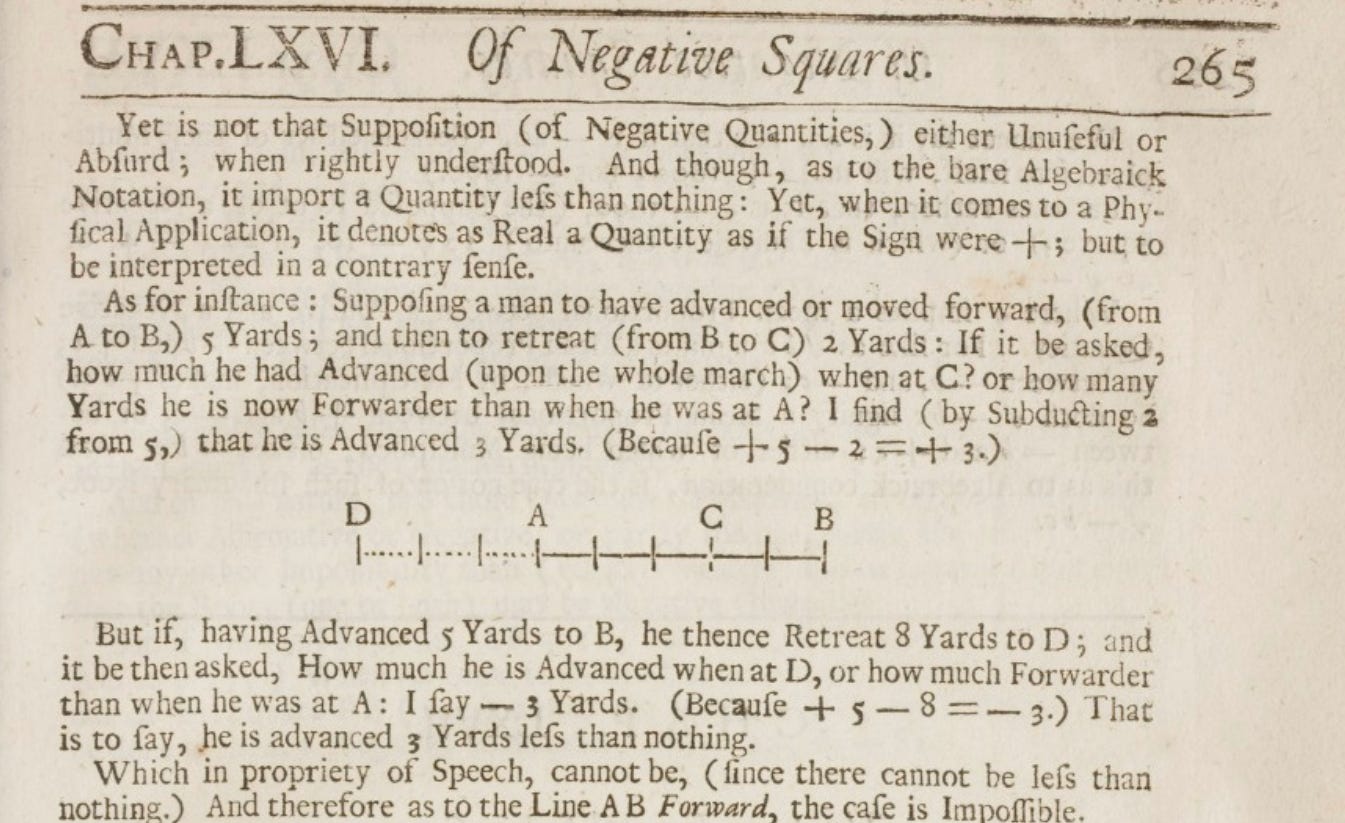
Finally, in 1829, Ernst Fischer used number lines to depict positive and negative numbers and to graph the values of a function. This is now a commonplace exercise in Algebra classes that students take in 8th or 9th grade.
The Number Line in the 20th Century
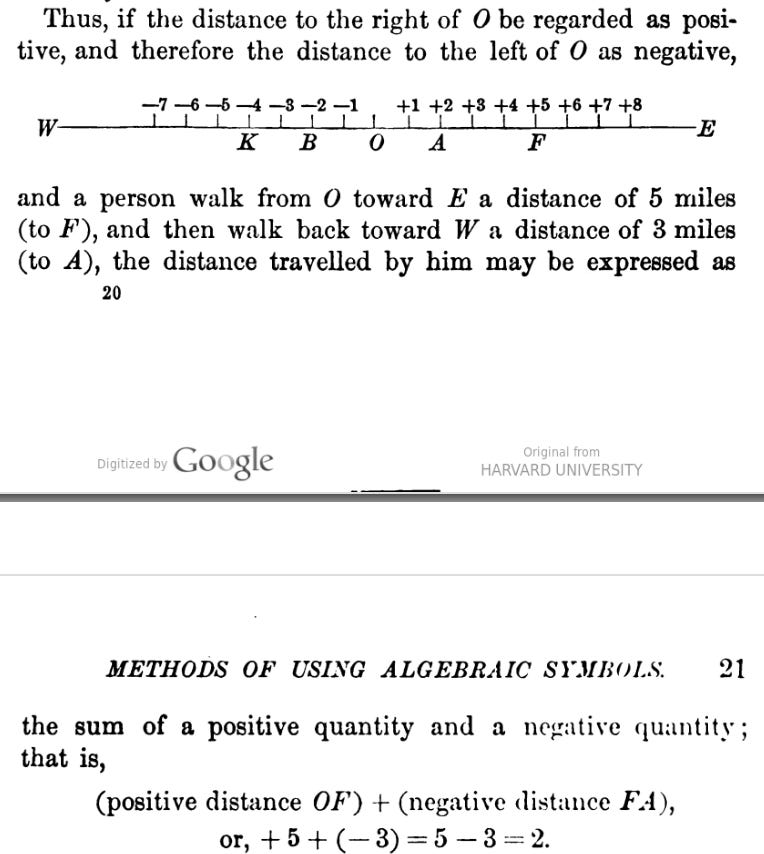
Near the turn of the 20th century, we see the number line being introduced as a pedagogical tool by Fletcher Durell and Edward R. Robbins in their textbook, A School Algebra Complete (1897). From the excerpt below, it is clear that they are not appealing to number line as a well-understood tool of math students, but as a new one. Here they use it to explain adding and subtracting negative and positive numbers.
New Math and The Number Line
Surprisingly, it wasn’t until as late as the 1950’s that the number line began to be introduced into teaching in the primary and secondary mathematics curriculum. The School Mathematics Study Group (SMSG) was created in 1958 in response to the launch of Sputnik by the Russians. The United States saw itself outdone by Russia and blamed (perhaps rightly so) poor mathematics education. The SMSG brought together a group of Ivy League mathematicians to create “New Math”, best practices for teaching math to elementary, middle, and high school students…it was doomed to fail. Some point to the arguments between advocates and opponents of “New Math” as the first of the many battles into the “math wars” of the 20th century. Regardless, few will argue that “New Math” was a success. In spite of the backing of top-tier university academics and hundreds of millions of dollars in funding from the NSF, the SMSG failed to produce an effective curriculum.
It would be incredibly reductionist to place all the blame on the number line for the woes of New Math, but New Math (a widely recognized failure) was certainly behind the placement of the number line in U.S. mathematics curricula. A student’s exposure to the number line was initially set to be sometime after 6th grade, later this age was pushed to grades 3-5, and now today it is often introduced as early as first or second grade.
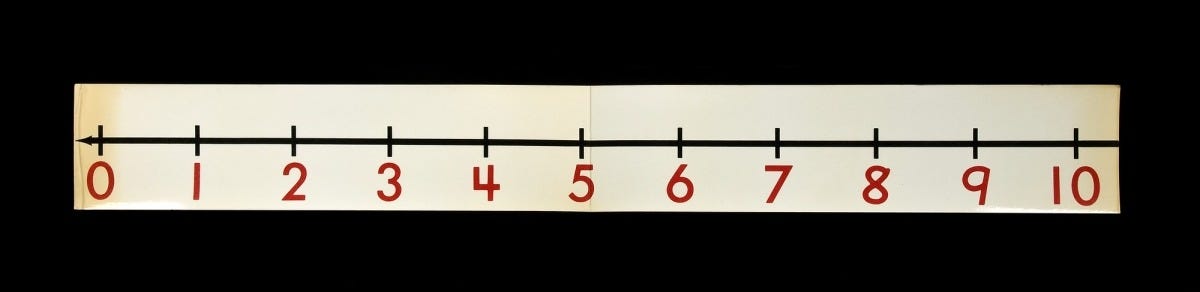
Many teachers were slow to accept the number line as a useful mathematical tool or a worthwhile part of the math curriculum, especially as New Math became recognized as deeply flawed. But eventually, the 1989 and 2000 NCTM Curriculum Standards firmly engrained negatives and the number line into the math curriculum we use today.
Students today struggle with the number line. If human nature is still the same as when it took a brilliant man like Descartes to invent the rudiments of the number line and analytic geometry in order to solve an unsolved problem, this should come as no surprise.
Understanding this history helps explain why the number line sits where it does in your child’s curriculum today, and why that placement deserves a closer look. In the next article, we’ll examine exactly what can go wrong when it’s introduced too early.