

I’ve taught math for over 10 years.
I’ve been to math conferences and done deep research into how to teach math well.
I’ve even done some writing about how to teach math and what’s broken with our approaches to teaching arithmetic.
My goddaughter is struggling with algebra. When my brother told me this during a recent visit, something shifted. Ten plus years of teaching math, attending conferences, and researching pedagogy suddenly felt intensely personal…
How kids (don’t) get math
As far as I can tell, there are four distinct ways students fail to understand math.
1. Kids misunderstand the vocabulary
This happens when a student doesn’t understand what a “numerator” or “denominator” is. The teacher uses the terms over and over and students do not have enough familiarity with them to immediately know what part of the fraction they are referring to.
2. Kids misunderstand the symbols
This happens when a student doesn’t understand what it means to write a number in smaller font as a superscript (an exponent) or what “f(x)” signifies.
3. Kids misunderstand the logic
This happens when a student knows what the exponent means and signifies, but has not thought through the logic of why this simplification is true:
Following the exponent rule that “you subtract the exponent in the numerator from the exponent in the denominator” is not real understanding.
4. Kids (and teachers) misunderstand what it means to understand math
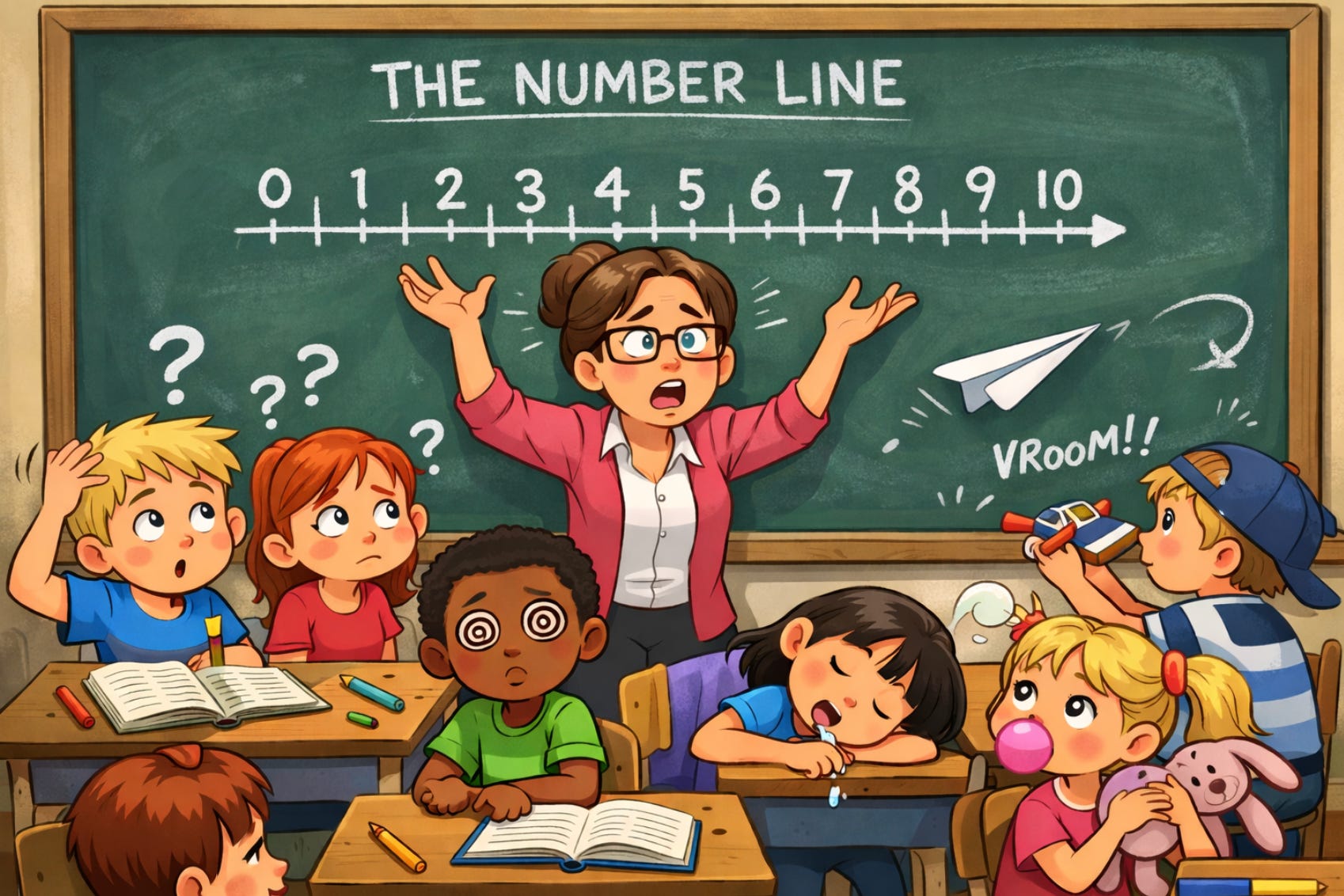
The first three are surface misunderstandings. The fourth is deeper and far more dangerous. Kids sometimes think that they understand math when they really do not. In lower grades, this looks like kids memorizing algorithms without understanding why they work. Or it looks a kid who knows all his multiplication facts, but is unable to use them to solve new multiplication problems mentally.
In later grades, this usually manifests itself in bigger ways. Kids struggle with algebra or calculus after getting straight A’s in math until that point.
Learning math without truly understanding it is often referred to as “algorithmic” understanding. You know the algorithm, but you don’t know why or how it works.
What Even the Good Teachers Miss
Any good math teacher is familiar with the first of the three distinctions I made above. What I think even the best math teachers miss is the fourth. Many teachers think their students understand division once they can do the division algorithm. Many teachers think their students get “solving linear equations” once they can do all the problems of that type in the textbook.
An essential part of including this fourth type of understanding in the math classroom is increasing what some educators call “meta-cognition”. Early in my teaching career, during a one-year stint at Mathnasium, I encountered this approach and it reshaped my own thinking. After a student provides an answer to a mental math problem, tutors are encouraged to ask them “how did you get that?” even if the answer was correct. This serves a double purpose. It allows the tutor to correct the exact mistake in the student’s logic (if there was one), but it also fosters in the student a habit of thinking about one’s thinking.
When a student can correctly explain his correct thinking about his correct solution to a problem, then he really understands it.
The Solution
Unfortunately, I don't have the solution. I probably never will. But I do know that the responsibility ultimately falls on teachers (like me). It’s a centuries-old problem that has spread because of the way teachers have learned and retaught mathematics. The problem goes back to the very foundations of mathematical thought.
The Ancient Greeks said that number included 2, 3, 4, 5… and so on. It was not a settled matter, but for the most part they did not consider that 1 was a number. And zero (nothing) was certainly not considered a number. Fractions, negatives, irrational numbers were far removed from consideration.
When my goddaughter struggles with negative numbers, she's wrestling with the same conceptual leap that took mathematicians centuries to accept.
Over the centuries, mathematicians broadened their definition of number to include things like fractions and negatives, eventually even including irrational numbers like π or the square root of 2. Why? Generally speaking, they were to solve mathematical problems that up until that point were thought to be unsolvable.
Number, redefined by mathematicians over the centuries, is presented as one coherent and complete concept to the very young, when in fact it has been defined, redefined, and fought over by mathematicians of the highest caliber over the centuries. I hope to explore this in future articles.
Brilliant mathematicians over the course of history struggled or even outright refused to accept fractions, negatives, irrationals, algebra, calculus… into their mathematical schematic. If a 4th grader struggles with fractions or decimals, they’re in good company and we shouldn’t be surprised.
A New Enterprise
I believe that math education often fails because we teach the symbols and procedures of mathematics while forgetting the centuries of human struggle that gave rise to those symbols, and we teach the manipulation of symbols as if it were mathematics. Until teachers re-learn math from the ground up themselves, no curriculum reform can fix math education.
I’ve decided to start writing a series of articles about important concepts in math that I think are all too often poorly taught to students or misunderstood by teachers. This will go beyond my earlier post of a resources toolkit. I’m hoping to formulate a collection of articles in a new section of my Substack site, Teaching Math Rightly, that will range from articles for parents and teachers to practical classes and exercises.

When I think of my goddaughter working through her algebra, I don’t just see a struggling student. I see someone stepping into a centuries-long debate about what numbers really are.
At the end of his time in Brazil, Feynman was invited to give a lecture about his time teaching in Brazil. Besides students, there would be Brazilian professors and government officials there also. Feynman made them promise he could say anything he wanted to at his lecture. They replied that he certainly could, Brazil was a free country.
So I come in, carrying the elementary physics textbook that they used in the first year of college. They thought this book was especially good because it had different types of typeface – bold black for the most important things to remember, lighter for less important things, and so on.
Right away someone said, “You’re not going to say anything bad about the textbook, are you? The man who wrote it is here, and everybody thinks it is a good textbook.”
“You promised I could say whatever I wanted.”
The lecture hall was full. I started out by defining science as an understanding of the behavior of nature. Then I asked, “What is a good reason for teaching science? Of course, no country can consider itself civilized unless … yak, yak, yak.” They were all sitting there nodding because I know that’s the way they think.
Then I say, “That, of course, is absurd, because why should we think we have to keep up with another country? We have to do it for a good reason, for a sensible reason; not just because other countries do.” Then I talked about the utility of science, and its contribution to the improvement of the human condition, and all that – I really teased them a bit.
Then I say, “The main purpose of my talk is to demonstrate to you that no science is being taught in Brazil.”
Feynman then told them the textbook had not any shred of science anywhere in it. The one “experiment” in the book was a fake experiment. It showed balls rolling down an inclined plane and it reported how fast the balls were moving at the bottom. But no one had done that experiment in real life since the formula used did not account for rotational inertia and the true speed of real balls would be 5/7 of the “answer” the book reported. The author of the Guidebook to Mathematics showed a replicated illustration of the “fake experiment” while giving a presentation at a large and famous biotech company in California. Only 1 out of 20 scientists could detect that it was a fake experiment.
Feynman also illustrated his criticism of that textbook by a public experiment:
“I have discovered something else,” I continued. “By flipping the pages at random, and putting my finger in and reading the sentences on that page, I can show you what’s the matter – how it’s not science, but memorizing, in every circumstance. Therefore I am brave enough to flip through the pages now, in front of this audience, to put my finger in, to read, and to show you.
So I did it. Brrrrrrrup – I stuck my finger in, and I started to read. Triboluminescence. Triboluminescence is the light emitted when crystals are crushed…
I said, “And there, have you got science? No – you have only told what a word means in terms of other words. You haven’t told anything about nature – which crystals produce light when you crush them, why they produce light. Did you see any student go home and try it? He can’t.”
“But if, instead, you were to write, ‘When you take a lump of sugar and crush it with a pair of pliers in the dark, you can see a bluish flash. Some other crystals do that, too. Nobody knows why. The phenomenon is called ‘triboluminescence.’ Then someone will go home and try it; then there’s an experience of nature.” I used that example to show them, but it didn’t make any difference where I would have put my finger in the book – it was like that everywhere.
Feynman here uses the phrase that his father Melville had used about inertia: “Nobody knows why.” Instead of worrying about losing face, instead of projecting an image of knowing everything, Richard Feynman knew that being perplexed and admitting that you don’t know was part of wonder and led to curiosity, imagination, and more intense observation of nature, thinking and learning all the more.
At the end of the lecture, Feynman concluded that:
Finally, I said that I couldn’t see how anyone could be educated by this self-propagating system in which people pass exams, and teach others to pass exams, but nobody knows anything. “However,” I said, “I must be wrong. There were two students in my class who did very well, and one of the physicists I know was educated entirely in Brazil. Thus, it must be possible for some people to work their way through the system, bad as it is.
However, Feynman was not wrong, he was mistaken. The two students who did well were not educated in Brazil; they were recent transfer students. The Brazilian physicist was educated during a war where all the professors were absent, and he taught himself from books outside of the system. Feynman wrote, “I didn’t expect that. I knew the system was bad, but 100% - that was terrible.”
While at Los Alamos, Feynman gave a lecture entitled “Some Interesting Properties of Numbers.” In the book Genius James Gleick relates how this lecture based on an equation Feynman wrote in his notebook at the age of 14 impressed the “mighty minds” of the Los Alamos scientists:
He now repeated the assertion he had written elatedly in his notebook at the age of fourteen, that the oddly polyglot statement eπi + 1 = 0 was the most remarkable formula in mathematics. Algebra and geometry, their distinct languages notwithstanding, were one and the same, a bit of child’s arithmetic abstracted and generalized by a few minutes of the purest logic. “Well,” he wrote, “all the mighty minds were mightily impressed by my little feats of arithmetic.”
The beauty of this equation was the subject of a lecture Feynman gave at Caltech called “Basic Algebra.” An expanded version of the contents of this lecture are the basis of chapter 14 of this Guidebook to Mathematics. The fourteen-year-old Richard Feynman had found a way to prove the Pythagorean theorem (the squares on the sides of a right triangle containing the right angle added together equal the square on the side across from the right angle, the hypotenuse) and talk about sine and cosine functions without using a triangle at all, but by following the logic of basic algebra and imaginary numbers. Feynman understood clearly that it did not matter how you proved something and that, in this case, alternate proofs revealed a beautiful connection between the seemingly disparate subjects of geometry and algebra.