


What is 2,756 ÷ 13?
I was stumped. I was proctoring a study hall in my first year of teaching, and a student came to me for help with this question.
I had just graduated from Rice University with a Master’s in Applied Physics, and I was stumped by a 4th grade math problem.
Complex Analysis? No problem.
Linear Algebra? Piece of cake.
Partial Differential Equations? Got it.
Long Division? Nothing.
But I could figure it out, right? Wrong.
I had no foundation of understanding to build on. I had no tools to figure out how to do long division again. I was never taught why it works.
If someone had asked me to do Proposition 1 from Book III of Euclid’s Elements, I could have easily demonstrated it. In that class, I really learned why math worked.
I understood it. So I remembered it.
Nobody ever taught me to understand long division. So I couldn’t remember it.
How Kids Learn Long Division
The algorithm that most of us learned in school goes by the name “long division.” It is actually the middle of three similar algorithms. There is a longer one that shows why it works, and a shorter one that is more efficient. Most teachers only teach the middle one.
For the 99% of readers who, like me, forgot how to do the standard long division algorithm, here’s a recap.
Teachers typically start by explaining that we are going to learn a new method for dividing big numbers.
Let’s use this as our example:
2756 ÷ 13 = ?
We first set it up in the half-box diagram.
Which is unexpected…
The addition algorithm: stack ‘em in order, addition symbol to the left.
The subtraction algorithm: stack ‘em in order, subtraction symbol to the left.
The multiplication algorithm: stack ‘em in order, multiplication symbol to the left.
The division algorithm: half-box shape with no division symbol in sight.

We should at least acknowledge these odd features, but most teachers don’t.
It’s hard enough for kids to learn all the steps to setting up the problem, let alone learning the steps to solving one.
“First, draw this funny shaped half box. Then, write the big number inside the box and the little number outside the box.”
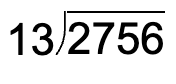
Now the teacher asks the students a very silly question: “How many times does 13 go into 2?”
The 2 in 2,756 is not really a 2, but a 2,000. At the age when students are struggling to understand place value, we completely ignore it for this algorithm.
Right off the bat, we’re confusing students.
Here is the way most students learn the standard algorithm:
Divide: How many times does the divisor (13) go into the “active” digit(s) of the dividend without going over? Write the quotient on top of the box, above the smallest “active” digit.
Multiply the number outside the box by the number we wrote on top of the box, and write this product underneath our dividend.
Subtract the product from step 2 from the active digit(s) of the dividend.
Bring down the next digit from the dividend and stick it on the end of the difference from step 3.
Repeat, now using the Frankenstein of a number we created in step 4 as our new “active” digits.
When kids can do these steps without assistance, they have “learned long division.” What they have actually learned is a ritual: Divide, Multiply, Subtract, Bring down…
Why does it work? Nobody knows…
The Extended Algorithm: The Real Long Division
In the early 20th century, there was a “great debate” over which algorithms (subtraction was especially contentious) should be taught in schools nationwide. There are in fact many other division algorithms that were used at various points in history, from the ancient “Galley Method” used by Muhammed Ben Musa in Kitab al-Jabr wa’l-Muqabala to Fibonacci’s prime factorization method in Liber Abaci.
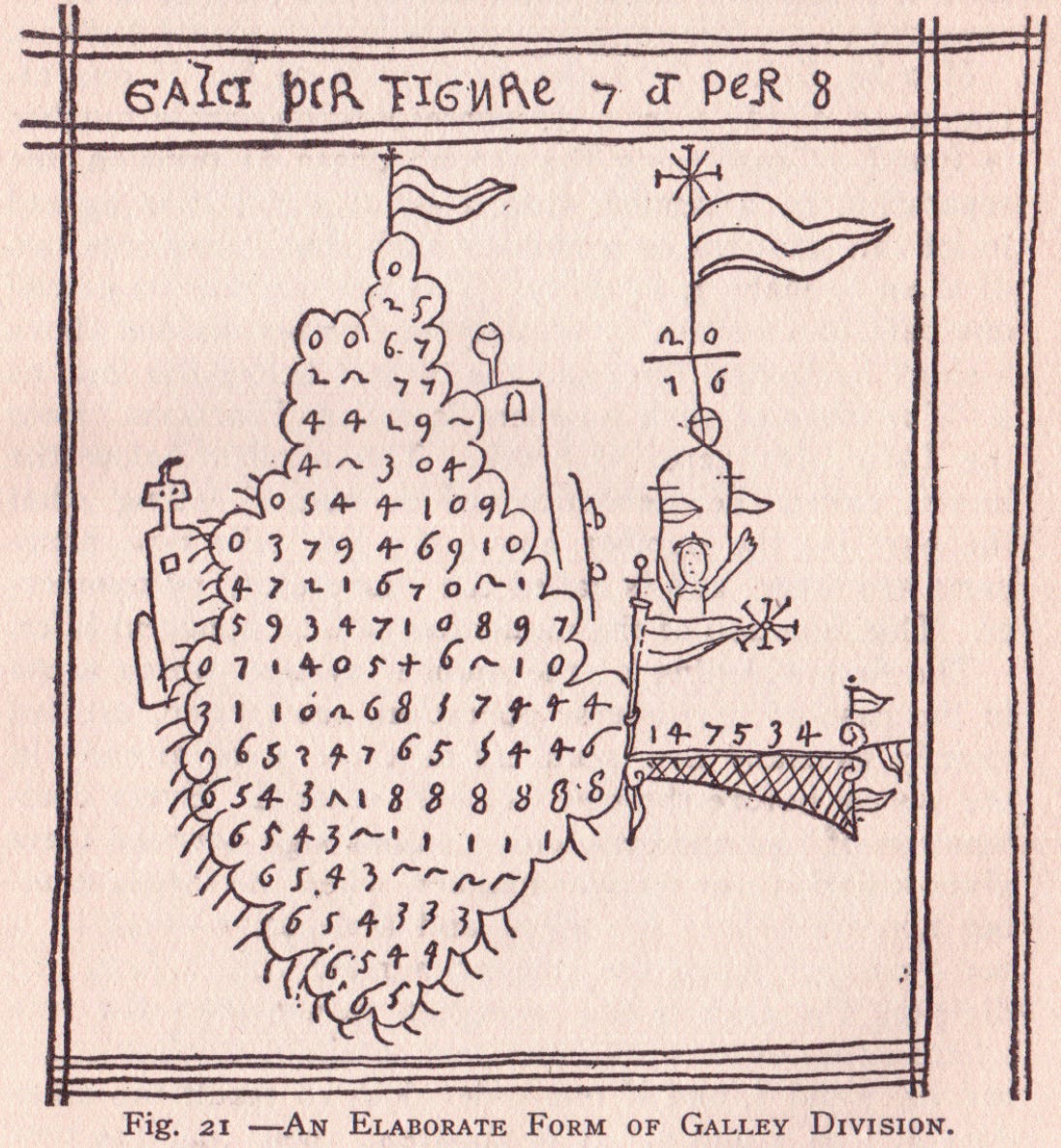
David Eugene Smith, historian of mathematics at Columbia University, argued in The Teaching of Arithmetic that it does not really matter what algorithm was taught. It was a means to an end. What matters is how the algorithm is taught. Students need to understand.
In the case of division, Smith points out that it is better to first teach an extended algorithm to facilitate a child’s understanding. The extended method is explained, and only after his students understand does a teacher go on to teach an abbreviated form, like the standard algorithm.
He argues the following:
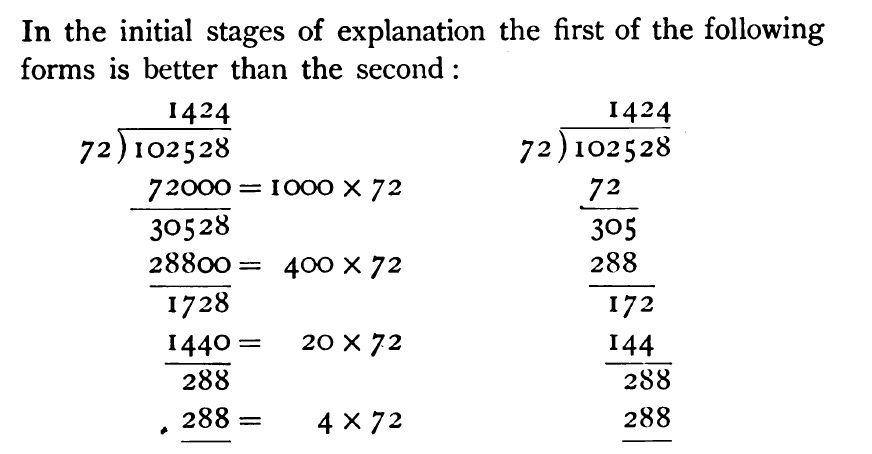
Most of us are accustomed to learning only the second of these two algorithms, but it is the first one that really shows us what’s going on. Just as multiplication is repeated addition of multiples, division is repeated subtraction of multiples. In the example above, it is clear from the extended algorithm (left) that we subtract 1000 × 72, then we subtract 400 × 72, then we subtract 20 × 72, then finally we subtract 4 × 72. Nothing remains of the initial 102,528, and so there is no “remainder.”
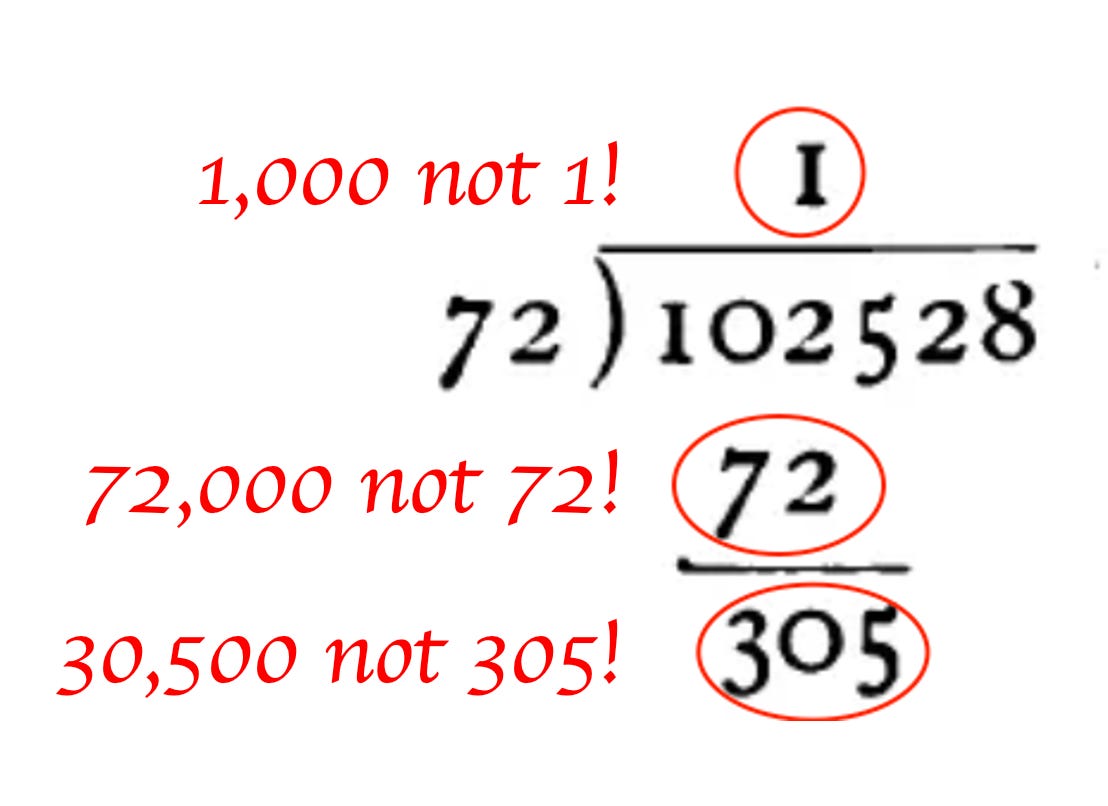
These steps are not made clear by the standard long division algorithm on the right side, as the picture below exemplifies.
But if we are going to teach an abbreviated form of the extended long division algorithm, we might as well teach the real short division algorithm.
The Short Division Algorithm
There is a shorthand to the standard long division algorithm that is actually worth teaching to students after they understand the extended algorithm outlined above.
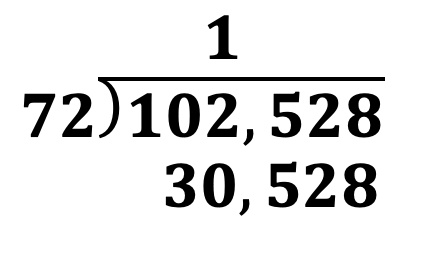
Step 1: Set up the problem as is typically done. Divide, multiply and subtract mentally. Write the remainder (30,528) in the line below.
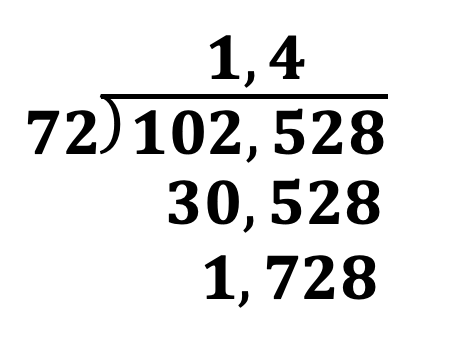
Step 2: Repeat, this time dividing into the remainder from step 1 (30,528).
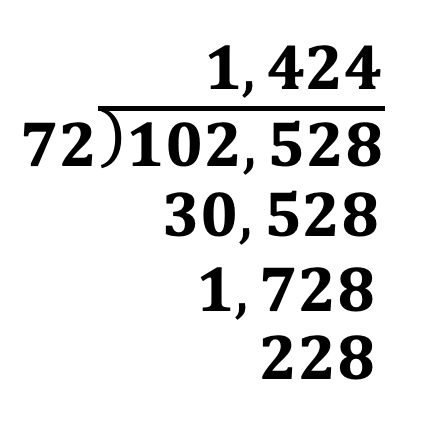
Step 3: Repeat again for the new remainder (1,728). If the final number can be divided evenly by the divisor, complete the quotient. If the remainder cannot be evenly divided, it is the “remainder”. There is no need to write the final step of 288-288 = 0.
The Real Reason to Learn Long Division
We have calculators in our pocket that tell us the answer to a division problem if we ask, “Hey Siri, what is 2756 divided by 13?” …“212”
So why teach algorithms? Long division should be taught because it is one of the foundation stones that students will need to build on to understand higher level math.
In Algebra 2, students typically learn about polynomial division. Polynomial division is a more generalized version of long division.
2756 ÷ 13 is equivalent to the polynomial division problem:
In both cases, you are subtracting multiples of the divisor repeatedly until nothing remains. The variable x just stands in for the base. If x =10, the answer simplifies to 212.
With true understanding of the division algorithm, children have the strong foundation they need to easily understand polynomial division in algebra. In my experience as a teacher, most algebra students struggle to understand polynomial division and eventually just memorize the steps. Few truly understand why it works.
If we are going to teach algorithms without understanding, we’d be better off handing them a calculator.
The slow path is the best path. In fact, it is the only path if we want to be teachers worthy of the name.
When I dug my heels in as a teacher and forced myself to understand the division algorithm, it genuinely opened a new world of understanding and computational ability. If only someone had taught me that way thirty years ago, I might have had something to offer the student in study hall.