

Johnny (not his real name) stands at the board in my geometry class. He’s done everything right so far. He has drawn the diagram, labeled the points, followed every construction step.
I ask him: “Do you have a proof?”
Silence.
Not because he is unprepared, but because he doesn’t understand what a proof actually is and he doesn’t know that the text he’s been staring at follows a hidden architecture that makes the proof almost inevitable, if you know how to look.
That’s what this article is about.
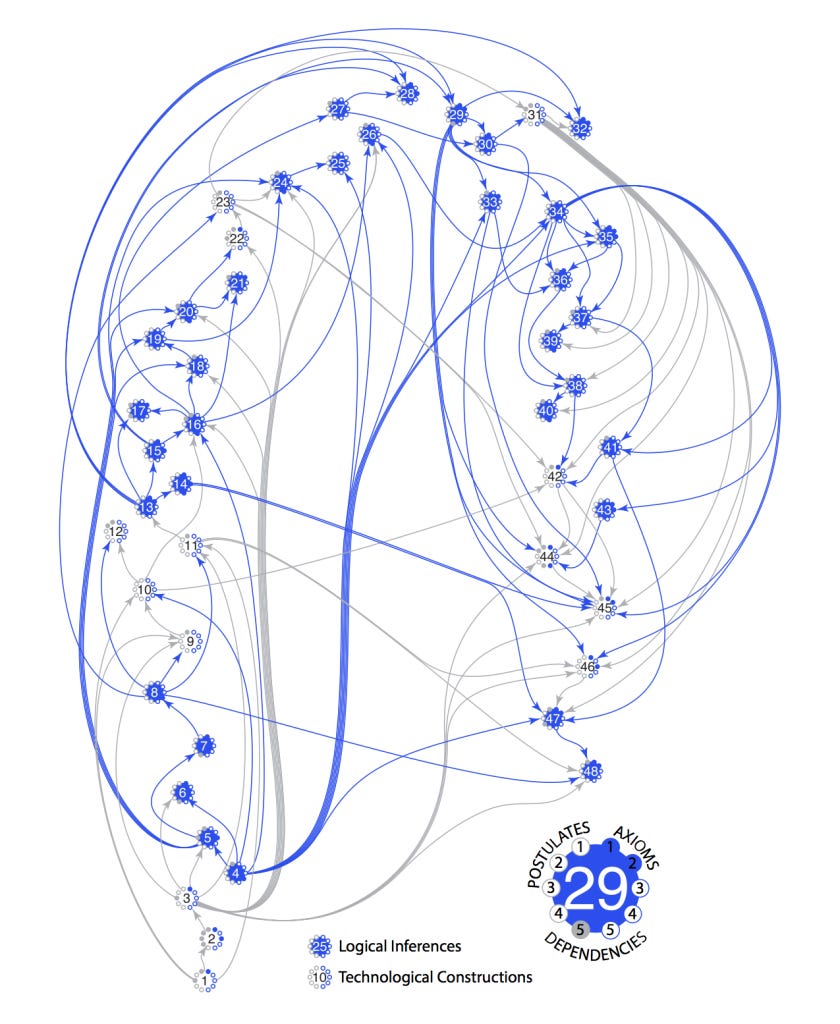
Euclid’s Elements is one of the most carefully ordered books ever written. Nearly 500 theorems and constructions. Each one built on the last, like bricks in a wall. The argument of Book I is one long, unbroken logical tapestry. The diagram below beautifully maps the entirety of Book I with all its interdependencies.
Don’t skip propositions. Don’t move on until you understand the previous proposition. Once you truly understand one, it’s very hard to forget, at least in outline.
What some students and teachers don’t realize is that every single proposition in the Elements has the same underlying structure. If anything changes, only one or two of the steps in the structure are missing. Once you see this, the whole book opens up.
The ancient geometer Proclus described it best. Sir Thomas Heath quotes him at length in his translation of the Elements:
“Every problem,” says Proclus, “and every theorem which is complete with all its parts perfect purports to contain in itself all of the following elements: enunciation (πρότασις), setting-out (ἔκθεσις), definition or specification (διορισμός), construction or machinery (κατασκευή), proof (ἀπόδειξις), conclusion (συμπέρασμα).”
Six parts. Always the same six parts. Here’s what they mean in practice.
The Six Parts of Every Proposition (Actually Seven)
Proclus counts six. Modern editions sneak in a seventh. More on that in a moment.
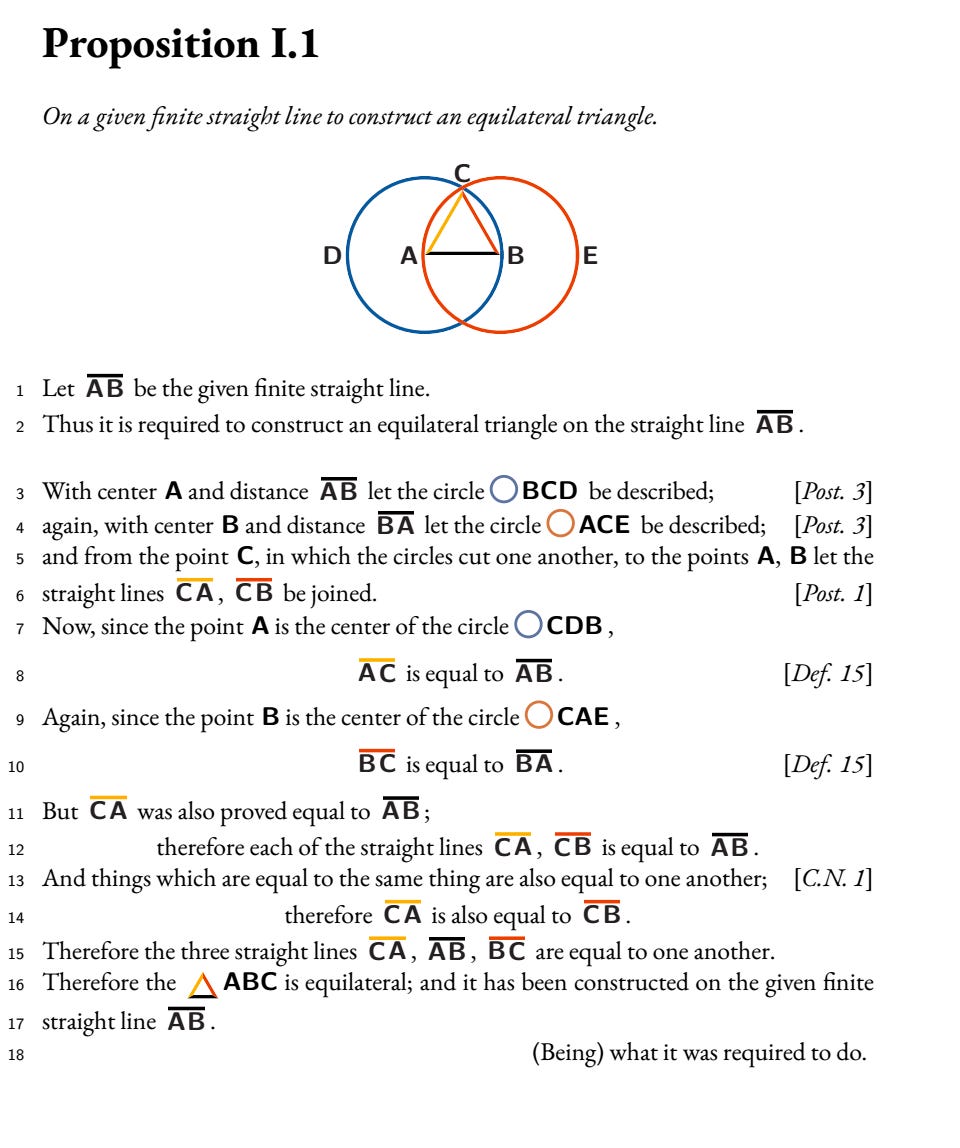
Let’s use Proposition I.1 as our example throughout. The goal: construct an equilateral triangle on a given line.
1. Enunciation The opening sentence states what is given and what is sought, in the most general terms possible. In most editions, it’s italicized.
“On a given finite straight line to construct an equilateral triangle.”
Philosophically, this comes first. Practically, it’s often too abstract to be a useful starting point for students. Start with the exposition instead.
2. Exposition (Setting-out) Begins with “Let...be the given...” This is where the general enunciation gets grounded in a specific diagram.
“Let AB be the given finite straight line.”
First step when studying a proposition: find this phrase, locate the given in your diagram, and draw it accurately with a straightedge and compass.
3. Specification Begins with “Thus it is required...” for problems, or “I say that...” for theorems. Restates what is sought, now in terms of the specific diagram.
“Thus it is required to construct an equilateral triangle on the straight line AB.”
This one phrase tells you everything. Problems and theorems are fundamentally different: problems ask you to construct something; theorems ask you to prove something. Proposition I.4, the famous Side-Angle-Side theorem, is the first theorem in Book I.
4. Justifications This is the bonus part. Proclus didn't count it because Euclid's original manuscripts didn't include it. But for a student facing that wall of text, it may be the most important of all.
Most modern editions include margin references, “Post. 3,” “Def. 15,” “C.N. 1,” that cite the definition, postulate, common notion, or prior proposition being used at each step.
Before reading the construction and proof, scan the justifications first. They function as an outline. In Proposition I.1, the justifications are:
Post. 3: Draw a circle
Post. 3: Draw a circle
Post. 1: Draw a line between points
Def. 15: All radii of a circle are equal
Def. 15: All radii of a circle are equal
C.N. 1: Things equal to the same thing are equal to each other
Six steps. Now the construction and proof are no longer a mystery. There is a clear path to follow.
5. Construction Everything beyond the given gets drawn here. Euclid instructs you to draw circle BCD with center A and radius AB, then circle ACE with center B and radius BA.
Draw it yourself, following the construction step by step. Don’t copy the figure from the book. The constructed diagram isn’t decoration. It is central to the argument.
6. Proof The rigorous argument. In Proposition I.1: AC and AB are radii of the same circle, so AC = AB. BC and BA are radii of the same circle, so BC = BA. By Common Notion 1, things equal to the same thing are equal to each other, therefore AC = BC. All three sides are equal.
Euclid’s proofs are essentially chains of syllogisms. You remember the form from logic class:
Major premise: All men are mortal.
Minor premise: Socrates is a man.
Conclusion: Socrates is mortal.
In Euclid, it looks like this:
Major premise (C.N. 1): Things equal to the same thing are equal to each other.
Minor premise: CA and CB are each equal to AB.
Conclusion: Therefore CA = CB.
The older manuscripts omit the major premises entirely. The justifications restore them in abbreviated form.
7. Conclusion Euclid restates the enunciation, typically applied to the specific diagram, confirming that we did what we said we’d do.
“Therefore the triangle ABC is equilateral; and it has been constructed on the given finite straight line AB.”
Each problem ends: Quod erat faciendum, Q.E.F., “We did what we said we would do.”
Each theorem ends: Quod erat demonstrandum, Q.E.D., “We proved what we said we would prove.”
I tell my students this is the final mic drop. They get a kick out of writing it on the board with some flair after a successful demonstration. Getting Q.E.F. and Q.E.D. mixed up is like stumbling across the finish line.

Back to Johnny at the Board
After the silence, I don’t give Johnny the proof. I start asking questions.
Not leading ones. Not “Isn’t AB equal to BC?” That’s just giving the answer in disguise. More like: “What is our goal with this proposition?” or “Do you remember what justifications Euclid uses in the proof?” And then I wait.
I learned this from a teacher/friend who also teaches Euclid’s Elements. Students must memorize each proposition at least through the construction. Once they’ve drawn it at the board, he asks: “Do you have a proof?” If not, he asks questions until they find it themselves, the way Socrates drew geometry out of an uneducated slave boy in the Meno.
As the year goes on, the other students start asking the questions.
That’s when you know something real is happening.
It Finally Clicks
I teach this structure to every student at the start of the year. I walk them through it carefully, show them how it maps onto the text, explain why it matters. For most students, it helps immensely.
For some, it goes in one ear and out the other.
Johnny came to me outside of class. He was drowning. He couldn’t understand the propositions, couldn’t memorize them, couldn’t see any shape in the wall of text in front of him. He was bright. He worked hard. But Euclid was a locked door.
I sat down with him one on one. We went through two propositions together, slowly, keeping the structure in front of us the whole time. Enunciation. Exposition. Specification. Justifications. Construction. Proof. Conclusion.
Something shifted. I could see it on his face.
Once he had the key, the door opened. He started acing every test. More than that, he became one of the best presenters in the class at the board, not because he had memorized the propositions, but because he actually understood them. There is a difference, and it shows.
A student who has memorized a proof recites it. A student who understands it can answer questions about it, defend it, and explain any step on demand.
That’s what the structure gives you. Not a shortcut, but a path to deep understanding. It's the thing that turns a wall of text into an argument you can hold in your head.
There’s a reason historians believe Euclid’s Elements was originally communicated orally. The verbosity, the repetitive chorus-like structure, the same form repeated nearly 500 times with all the propositions. It’s built for recitation, not just reading.
When your students can stand at the board and give a proof from memory, they’re not just doing geometry. They’re participating in a 2,300-year-old tradition of human beings reasoning together about what is certainly true.
Q.E.D.
I love this so much! Would relish the opportunity to teach a high school elective class on the Elements. Unfortunately, the monstrosity that is state-tested High School Geometry doesn’t resemble this at all.
I also love the anecdote about tutoring. We work so hard to avoid needing it, but 1-1 tutoring can unlock understanding in a real way for kids who are used to going along to get along in class.
Finally, have you ever read Euclid and His Modern Rivals? A great book about pedagogy that is still relevant today.