


Every other algorithm we teach children lines up the same way:
Numbers stacked. Operation symbol on the left.
Addition does it. Subtraction does it. Multiplication does it.
Then we get to division, and suddenly there's a half-box shape with no symbol in sight, and we expect children to just accept that.
They don't ask why. We don't either. But we should.
Is it possible to do division using an algorithm that is more similar to the other algorithms we teach? It seems like we should be able to. And we can.
I didn’t invent it, I only discovered it by reading Leonardo of Pisa’s Liber Abaci (1202).
Leonardo of Pisa (AKA Fibonacci) describes an algorithm for solving a division problem like this:
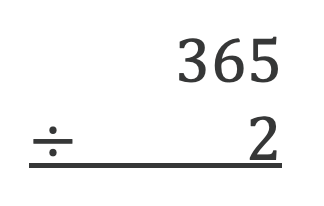
Starting with this simpler case, I will then extend it to a more complex one.
Fibonacci’s “Stack ‘em In Order” Algorithm
Surprisingly, Fibonacci demonstrates the algorithm moving from left to right.
Step 1: 3 ÷ 2 = 1, with a remainder of 1 (1 R1).
Write the 1 under the line, in the space beneath the 3, and write the remainder 1 above the 3, like so:
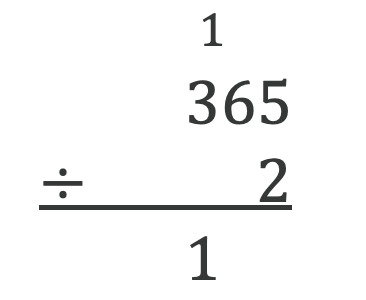
Step 2: 16 ÷ 2 = 8, with no remainder.
Write the 8 under the line, in the space lined up with the 6, like so:
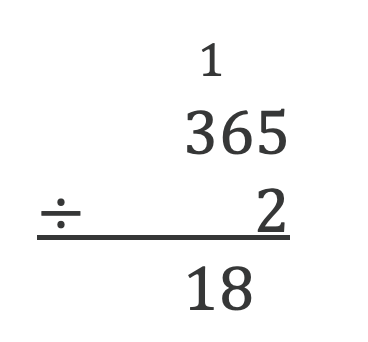
Step 3: 5 ÷ 2 = 2 R1.
Write the 2 under the line, in the space lined up with the 5, followed immediately by the remainder of 1, like so:
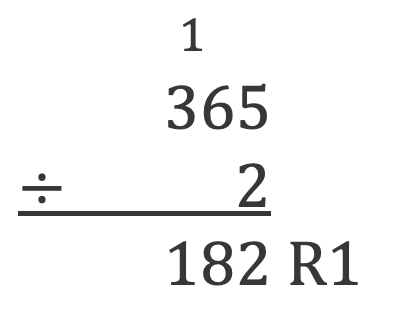
That’s it. Really not that complicated. It’s formally similar to other algorithms, and it’s not hard to understand: we approximated the quotient one place value at a time, then corrected for the approximation.
I love it. But what happens when the numbers get bigger?
When The Numbers Get Serious
Let’s look at a more complicated example, the one addressed by David E. Smith in The Teaching of Arithmetic. I have added some extensions to Fibonacci’s method in order to clarify place value.
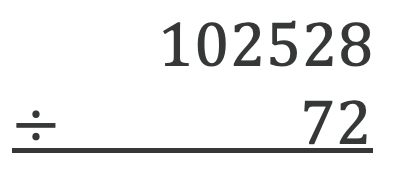
Step 1: Moving from left to right, we don’t reach a number greater than a multiple of 72 until 102. Then, we approximate 102,528 as 102,000 and correct for the approximation in subsequent steps.
102,000 ÷ 72 = 1000, with a remainder of 30,000. We write 1000 below the line. Then we add “528” to the remainder of 30,000 to make 30,528. This is our new dividend, so we cross out the 102,528.
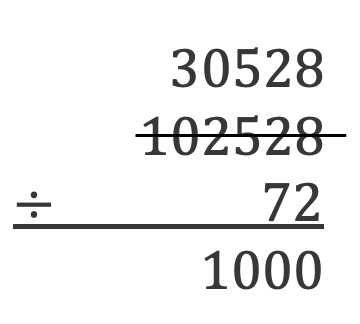
Step 2: We approximate 30,528 as 30,500. 30,500 ÷ 72 = 400, with a remainder of 1700. We write 400 below the 1000 and add “28” to our remainder of 1700 to make 1728, and we cross out 30,528.
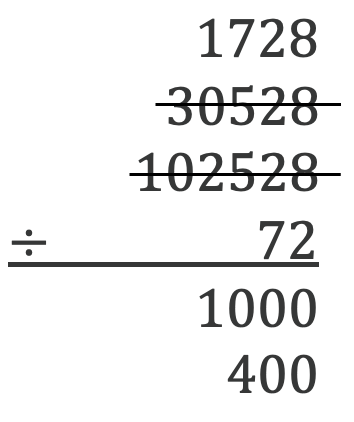
Step 3: We approximate 1728 as 1720. 1720 ÷ 72 = 20, with a remainder of 280. We write 20 below the 400, 288 above the 1728, and we cross out 1728.
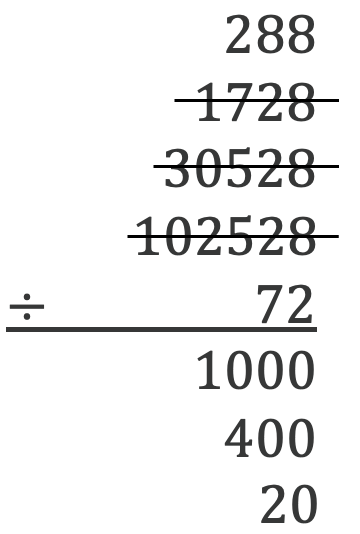
Step 4: We have 288 left as a dividend. 288 ÷ 72 is 4 with no remainder. Adding up all our partial quotients, we get 1424 as our final answer. If a remainder is left over, we include that in our quotient in the normal way.
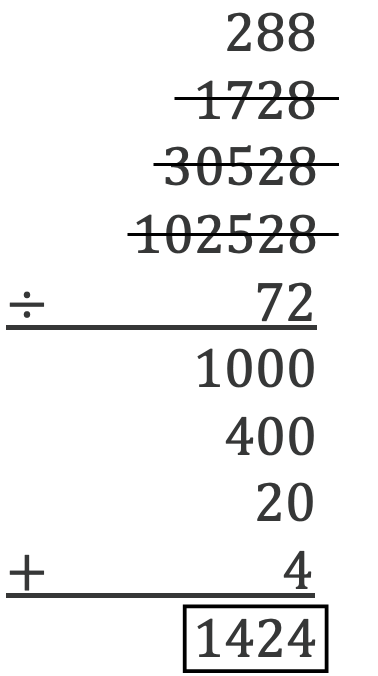
Place value is preserved at each step. Division is treated as repeated subtraction. Students can understand each step of the algorithm and thereby remember it years later.
Why Don’t We Teach It In Schools?
Perhaps we want an algorithm that students can do without thinking. Servile mathematics, what the Greeks called logistike, has been the focus of math curricula for many years. Before calculators, mindless rote calculation had its own justification. We no longer have that excuse. It is both useless and demeaning to teach students to perform an algorithm without thinking or understanding.
Most people are simply unaware of this algorithm. Most teachers and parents did not learn division this way, and teaching a “new” algorithm will be met with strong resistance. The slow path is ultimately the fast path and is well worth the difficulty.
This algorithm fosters understanding of place value, shows division’s true nature as repeated subtraction, and is formally similar to other algorithms.
It should be taught in schools.
The Galley Method
The “Galley Method” of doing division can be just as mindless as the standard long division algorithm, but it is far more beautiful. It requires close attention, and the result is so elegant it's easy to mistake for decoration rather than mathematics.
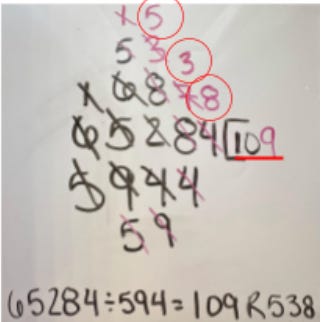
Anna Taylor explains the galley method solution to 65284 ÷ 594 in her article on The History of Long Division. Here is the completed problem:
Just look at the beautiful galley ship generated by solving this monster of a division problem:
315,843,843,309,862,431,584,384 ÷ 189,810,001,989,100,018,981
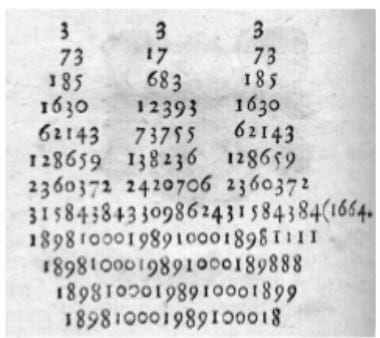
We’ll save the full mechanics for a future article.
David E. Smith argued in The Teaching of Arithmetic that the best algorithm should be taught, and that no algorithm should be standardized. He also argued that algorithms should lead to understanding, not mindless computation. When the standard division algorithm was standardized with the centralization of education, we ignored both pieces of advice.
Fibonacci’s “stack em” method is easy to understand, preserves place value at each step, treats division as repeated subtraction, and is formally similar to other algorithms.
It would be a mistake to standardize any one method. But teachers who aim to teach mathematics as a liberal art should choose a division algorithm that fosters understanding not servile obedience to arbitrary rules.
Next time a student finishes the worksheet early, hand them this instead.