


This is the first article of a series on Euclid’s Elements, Book I. Take your time. One per week is excellent.
The most important math textbook ever written hasn't been in most classrooms for a century.
Based on my own experience and that of others, I believe studying Euclid’s Elements is essential to a real mathematics education.
I will dedicate a few articles to the Elements, drawing on nearly ten years of teaching Euclid and the experience of numerous wise guides, more equipped to teach this masterpiece than myself.
In this first article, I will focus on some background and an introduction to the structure of the Elements. The next post in the series will have some practical ideas about how to study the book itself.
I will be referencing my new e-book in these posts, so I encourage you to grab a copy and follow along! I’ve removed the paywall from the book, so that now all subscribers have access.

Euclid’s Elements: Textbook of Textbooks
For centuries, Euclid’s Elements was the most read math textbook in the world. It still remains the most influential mathematical work ever composed.
His genius was not his originality. Many of the proofs included in the Elements were likely taken from other mathematicians.
His genius was in his ordering.
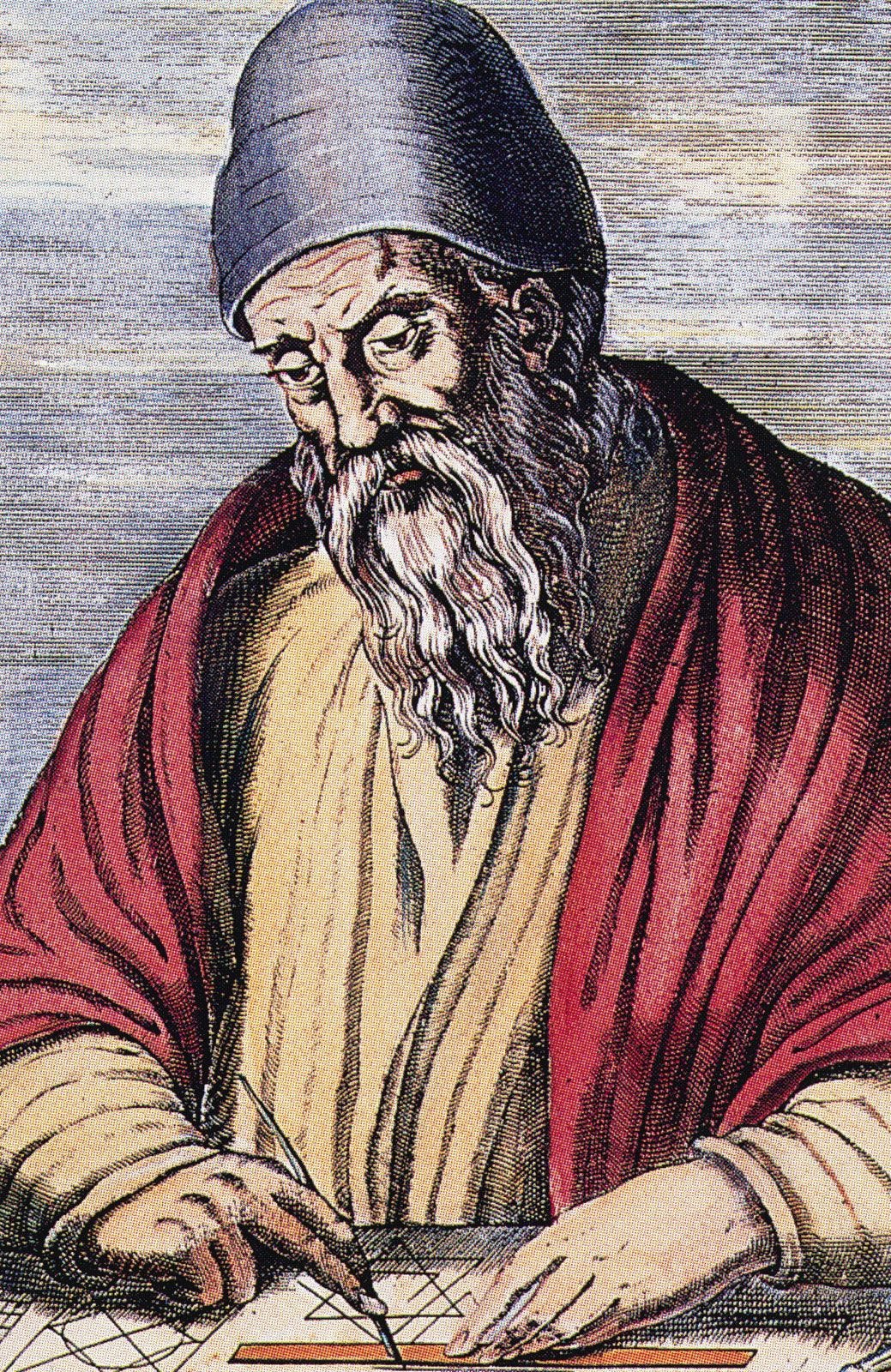
There are numerous theories about why Euclid ordered the Elements the way he did. One thing is for certain: logical flow was uppermost in his mind.
Each proof is based on previous axioms, theorems, and constructions. Over the course of the book, Euclid builds a complex tapestry of interwoven threads that on the whole compose a beautiful study of basic geometry and arithmetic.
Basic? Yes. Easy? No.
It is not a textbook in the modern sense of the word. It contains no exercises. The margins are left for notes, not for cutesy, unrelated, and unnecessary pictures of kids on skateboards or smiling dogs.
Praise for Euclid’s Elements
It is more than a textbook. It is a Great Book. It is widely recognized as such by highly intelligent individuals and by the entirety of civilization. It is the second most printed book in the Western world, only after the Bible.
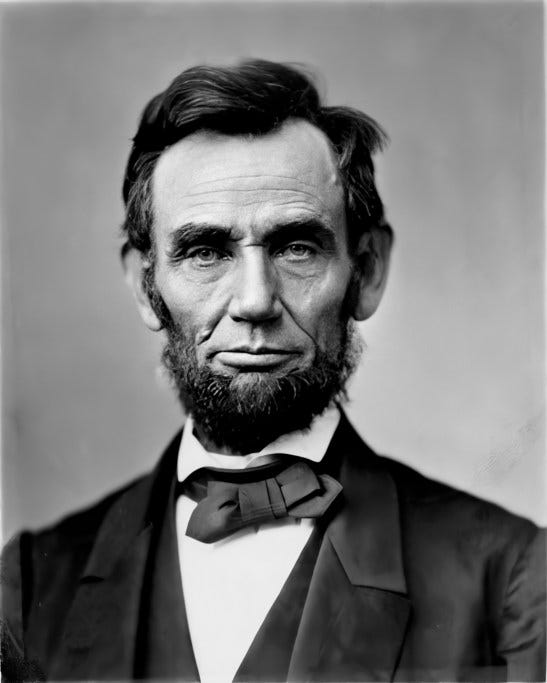
Abraham Lincoln famously decided to study Euclid when he was practicing law:
“In the course of my law-reading, I constantly came upon the word demonstrate. I thought, at first, that I understood its meaning, but soon became satisfied that I did not.” Lincoln said to himself, “You can never make a lawyer if you do not understand what demonstrate means.” Lincoln later said, “I left my situation in Springfield, went home to my father’s house, and staid there till I could give any propositions in the six books of Euclid at sight. I then found out what ‘demonstrate’ means, and went back to my law studies.”
- Abraham Lincoln, as cited by David B Hayes in his article on LinkedIn
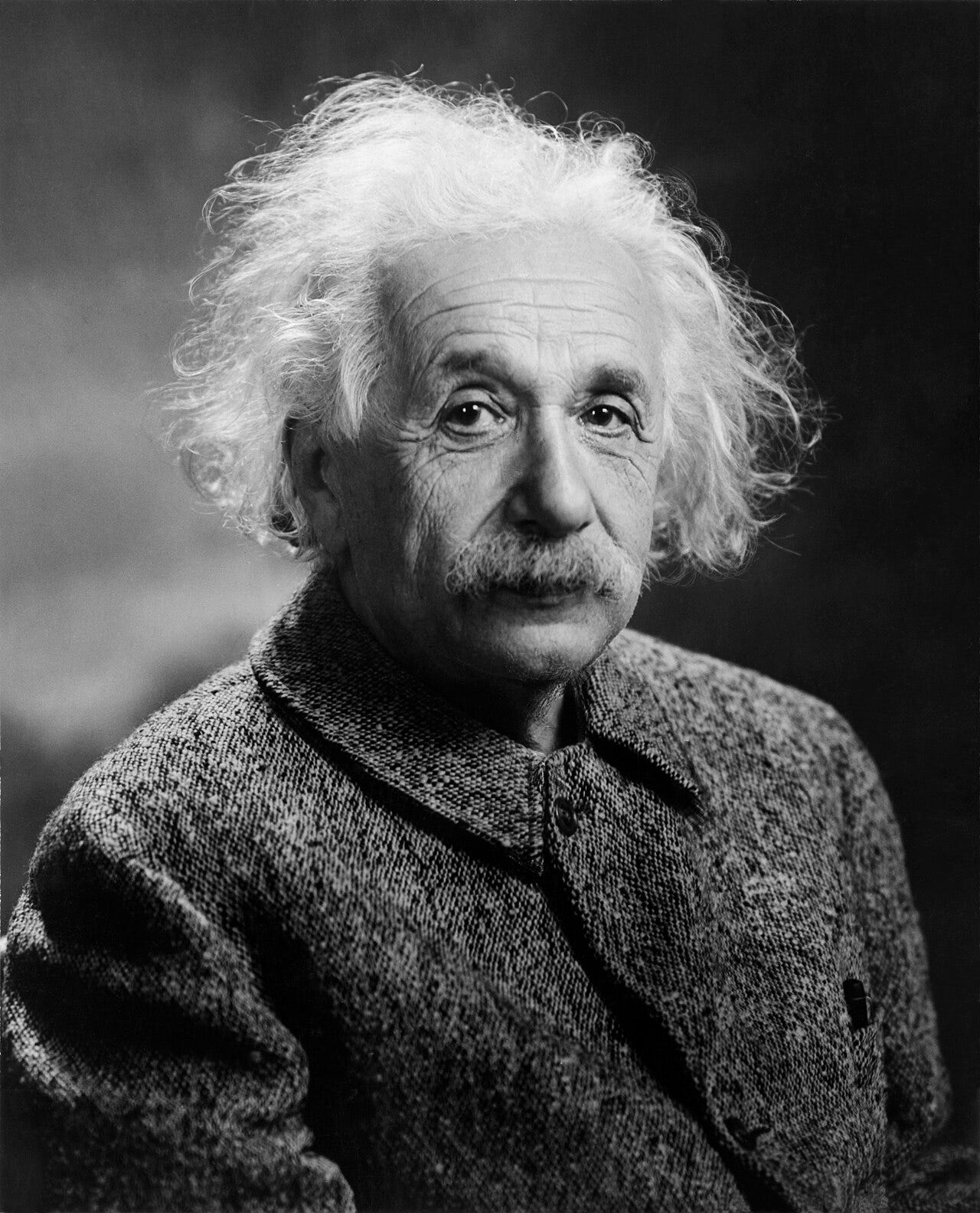

Albert Einstein said the following of Euclid’s Elements:
We reverence ancient Greece as the cradle of western science. Here for the first time the world witnessed the miracle of a logical system which proceeded from step to step with such precision that every single one of its propositions was absolutely indubitable - I refer to Euclid’s geometry. This admirable triumph of reasoning gave the human intellect the necessary confidence in itself for its subsequent achievements. If Euclid failed to kindle your youthful enthusiasm, then you were not born to be a scientific thinker.
-Albert Einstein, On the Method of Theoretical Physics (source), emphasis added
Einstein goes on to explain that Euclid’s Elements provides an excellent analogy for how theoretical physics should progress.
The Structure of Euclid’s Elements
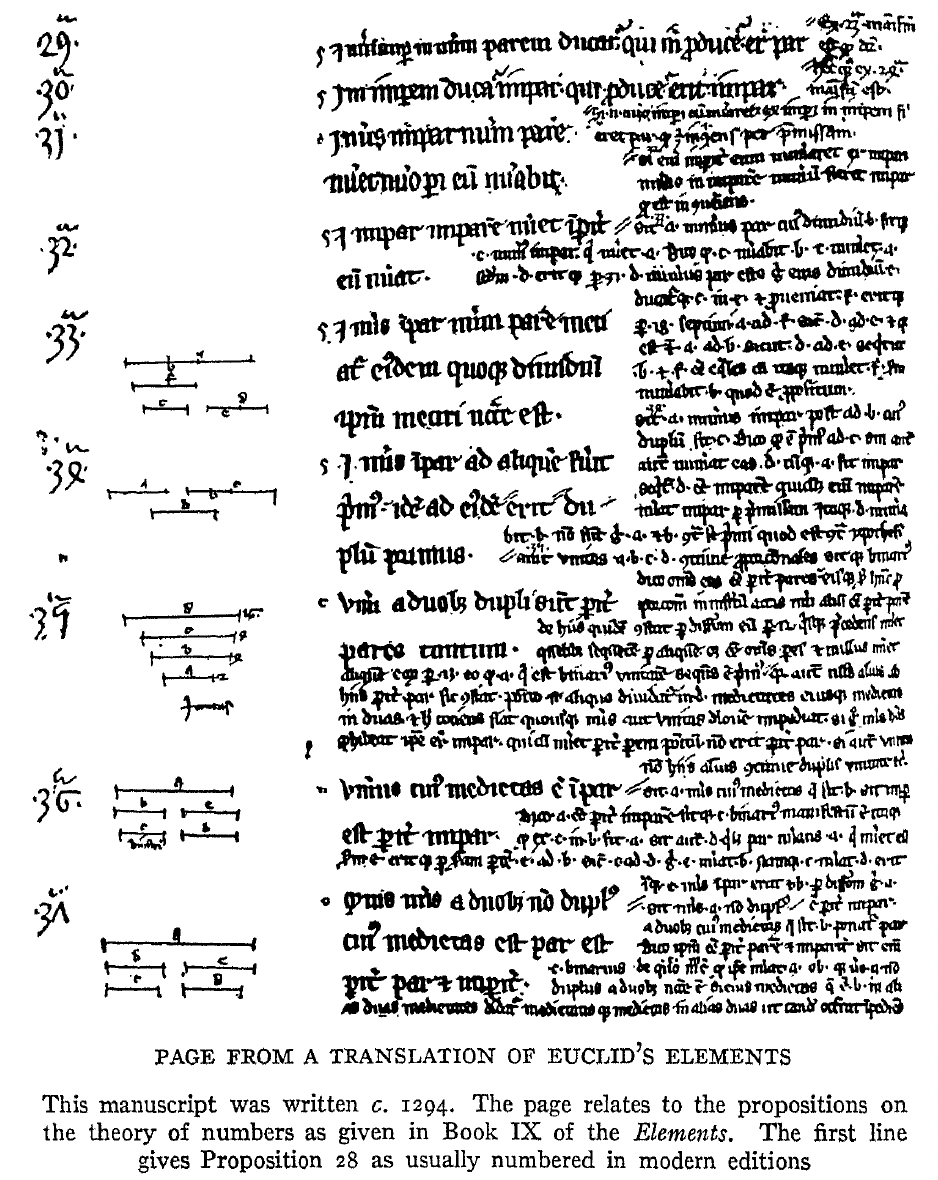
Euclid’s Elements is actually a collection of 13 Books total, each with about 50-150 proofs, called “propositions,” which demonstrate truths about geometry and arithmetic.
Each book begins with definitions, postulates, and common notions.
Definitions
The definitions are about what certain words mean. He defines a point as “that which has no part,” and a line as “a breadthless length.”
These are descriptions of mathematical objects which cannot physically exist. Once they are clearly defined, however, it is possible to make logical deductions about their properties and relations.
Postulates
Next up are postulates. These are statements about mathematical reality which are assumed either because they are unprovable or almost unprovable. For example, he postulates that it is possible to draw perfectly straight lines between points or that it is possible to extend a line indefinitely. These are statements about what is possible or true in the context of the Euclidean world of mathematics. They are not statements about what is possible or true in physical reality. A perfect line or a perfect point are physical impossibilities. But in the world of Euclid’s Elements, we must accept them as real.
The postulates can almost be thought of as mathematical rules. I often explain to my students that Euclid’s postulates are him telling us, “If you want to enter into my mathematical world, these are the rules. Accept the rules or do not enter.”
Common Notions
The common notions immediately follow upon the postulates.
If the postulates are assumed mathematical axioms, the common notions are general axioms.
They almost do not need to be assumed because they are part of common sense. Common sense tells us that if A = B and B = C, then A = C. And this is one of the five common notions. Common sense tells us that “the whole is greater than the part.” This is also one of the common notions.
Common notions are axioms of logic that every sane person knows to be true.
Mathematicians and Euclid’s 5th Postulate
It is important to keep in mind that Euclid’s axioms are his rules for his math. His math is often referred to as Euclidean geometry and arithmetic. Mathematicians like breaking the rules and playing games with new rules, however. So over the centuries, mathematicians have developed various other geometries and algebras based on different mathematical axioms.
One of the axioms of Euclidean 2-dimensional geometry (geometry on a flat plane) is that through any point not on a straight line there is exactly one straight line parallel to the first line. This is an equivalent statement of Euclid’s 5th postulate.
In hyperbolic geometry (geometry on a saddle-like curved surface), there is not just one but infinite straight lines parallel to a given straight line through a given point. In spherical geometry (geometry on a sphere, like a globe, for example), there are none.
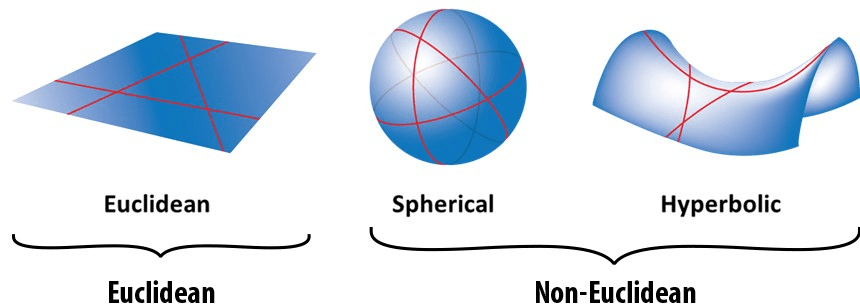
If the surface itself is curved, how can we talk about “straight lines”?
If a straight line is redefined as the path which traces the shortest distance between two points, we can talk about “straight lines” in spherical and hyperbolic geometries.
And what about “parallel” straight lines?
Parallel straight lines, as constructed in Euclid’s Elements, run perpendicular to a common straight line. Straight lines so constructed in hyperbolic geometry diverge from one another. In spherical (or more generally, elliptic) geometry, such straight lines converge. In Euclidean geometry, they never meet.
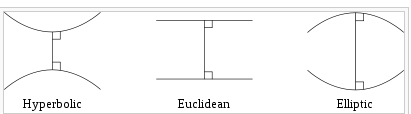
Euclid chose his axioms because they bear the most obvious relevance to the natural world. They are directly abstracted from experience with physical reality. More advanced geometries like hyperbolic and elliptic are fascinating, but Euclid’s world is the place to begin.
Final Thoughts
Little is known about Euclid the man. Most historians agree that he worked in the 4th century BC, a little after Plato and before Archimedes. His work was used in the Pythagorean school to teach mathematics, and it eventually made its way to the Western world.
For over 2,000 years after Euclid lived, the masterpiece survived as the textbook for geometry and arithmetic. You had not completed your liberal arts education until you had studied Euclid.
With the scientific revolutions of the 15th-19th centuries, the liberal arts in general (and Euclid’s Elements in particular) fell out of favor. Only with the classical education movement of the 20th century has Euclid’s Elements begun to make a comeback.
With this series, I hope to make the case that Euclid's Elements still belongs in any school that seeks to provide a serious education for its students.
New E-Book: Euclid in Color, Book I

All subscribers now have early access to a free e-book I recently finished editing with a few friends: Euclid in Color, Book I.